|
|
III. Camera
Because kites can come down as quickly as they go up, you'll want to avoid making a large investment in your camera. You'll probably want to find one with a plastic rather than metal body--it'll be lighter, less expensive, and more forgiving when it crashes. Because you can leave your camera focused at infinity, there's no need for an auto-focus camera. But because clouds do come and go, it's nice to have auto-exposure. Another issue is finding a camera that has a convenient shutter release that can be tripped while you're not around.
|
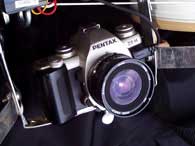 |
Pentax. I use two 35 mm cameras. My first choice is a Pentax ZX-M. It has manual focus, which costs less. It also has an optional electronic shutter release that I've connected to a servo meant for a radio-control airplane. Because of its common bayonet mount, it's easy to find a variety of less expense lenses. Finally, I've been very impressed with the way it has held up to the abuse it's received while dangling from a kite line.
|
|
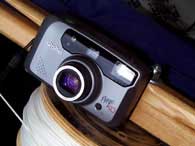 |
Rollie. My second choice is a Rollie Prego 90. Its chief advantage is that it has an intervalometer that automatically takes a photo from once every ten seconds to once an hour. This eliminates any other equipment needed to trip the camera's shutter. It has disadvantages, though. For one, the zoom lens is no wider that 28 mm (the disadvantages of this are discussed under lenses).For another, pictures are taken at set intervals, regardless of where the camera may be swinging at that moment. And it does have many features not needed for KAP, so it is more costly.
|
|
|


